


START HERE: 1. The Road Less Traveled; 2. Zen and The Clear White Light.
Tang ceremony in a kimono
By 1967, I’d spent my entire life among descendents of criminals (mine were respectable Irish pub-keepers I hasten to add), none of whom queried our British political model, and we took our dwellings—designed for 1880s winters in England—as God-given.
So we left Australia for booming Japan where a high-paying, low-demand job let me indulge what would become my favorite pastime, poking my nose into foreign cultures. What are their birth and funeral rites? Their marriages? Social hierarchies? Adolescent transitions? How do they handle crime? I almost drowned when I was my suddenly immersed in Japan’s ancient culture.
Even Nagoya’s exquisite window displays disturbed me. One window was devoted to what resembled a huge, brown sweet potato—in a delicately incised cedar box. Another displayed expensive medallions on silken ribbons,
and I could make no sense of the weird, pentatonic Muzak in every store and elevator. I went back to my hotel, threw up, and collapsed on the bed. Culture shock is shock. Who knew?
Like mine, Japan’s culture was borrowed too. It’s a version of China’s Tang Dynasty (618–907 AD) lovingly preserved, in amber. The bureaucratic system, Confucian rituals, Buddhist temples, court poetry, clothing styles and imperial grandeur? Pure Tang. Millions of clever Japanese spent a thousand years refining the Tang model (‘Confucian on the outside, Legalist on the inside’) to their insular needs.
Best of all? The Tang Dynasty was the Zen’s Golden Age1 . There were temples everywhere, all unique so my wife could indulge her passion for architecture while I looked around for a living Zen Master. Some temples—the most prosperous—boasted famous Zen Masters in the lineage but none had a living one. But at least the monks could understand my questions, a big step up from Australia. After a few months’ adaptation I found my culture immersion exhilarating.
The people, who were uniformly polite and formal, had obviously considering every element of their lives, like aesthetics for a very long time. My wife encouraged me to collect traditional Japanese pottery—an experience I enjoyed immensely, especially since my untaxed dollar income had three times today’s buying power. Even better, Zen and artistic pottery were almost synonymous. And when I found that pottery collectors paid more for the works of living potters..might I find my quarry amongst them? When I raised the possibility, a Japanese workmate he said there was a local potter whose recent Tokyo show had sold out in minutes. Would I like to meet him?
Who was that lady?
The young potter was chatting with a friend when we arrived, and invited all us into his home—an unheard-of gesture back then. As we seated ourselves around a low table on the tatami a young, kimono-clad woman entered quietly, bowed, and placed bowls before us.
Silently, and with minimal movement she wiped the tea utensils2 with a silk cloth, added matcha powder to the bowl, poured in hot water and whisked it into an emerald froth. She bowed and offered the bowl to my Japanese friend. He bowed, took the bowl with both hands, rotated it slightly, drank it in three sips, wiped the rim, admired the bowl, and passed it to me. When all four of us had been served, she stood up, bowed, and left the room as silently as she had come (only on the train home did I real that I had just seen a tea ceremony).
I congratulated my host on his Tokyo sellout but he deflected my praise to his teacher who, he said, was Abbot of a famous Zen monastery at 32, then resigned in middle age to take up pottery. His sensei would be giving a party at his home in Kyoto the following week. Would I like to go?
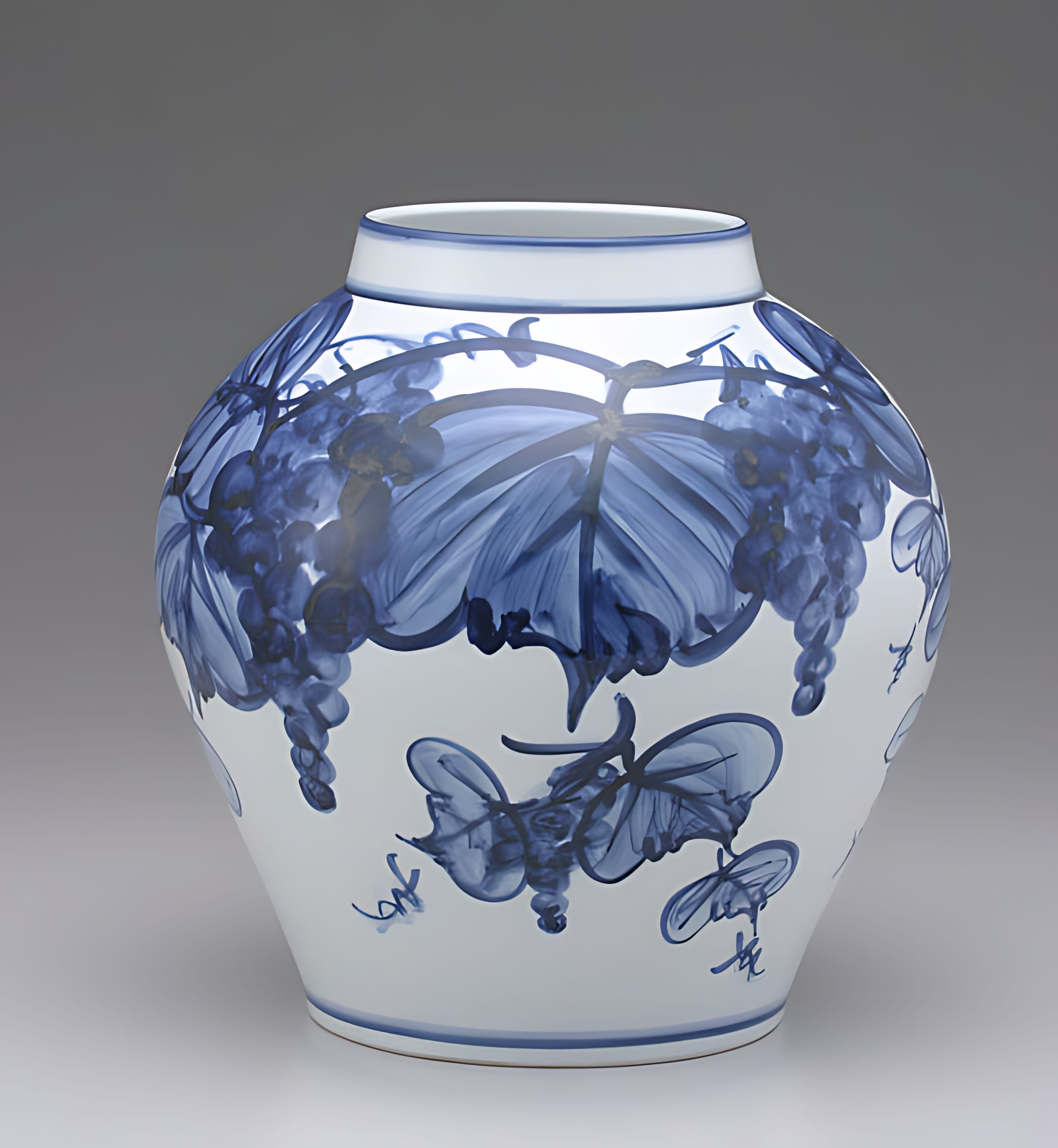
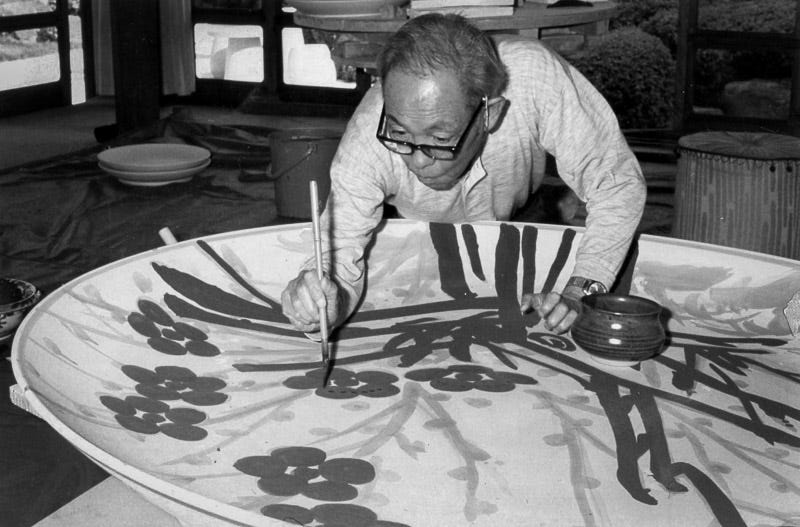
Kondō Yūzō, then in his sixties, was the master of blue-and-white porcelain, sometsuke, for which Japan’s Government had designated him a Living National Treasure. It seemed natural his home would be a masterpiece of wood and paper shoji that overlooked Kyoto’s rooflines to the rolling hills.
We were seated at a table covered in sushi platters when the apprentices prostrated themselves face-down and Kondō, in a somber yukata, floated across the lawn, seated himself and, in the same movement, raised a toast to my potter friend: “Your accomplishment in Tokyo honored me, your teacher. Now I honor you”.
Four more rounds of sake and he launched the best food fight I have ever seen.
After the debris was cleared my friend introduced me as a ceramics collector to Kondō. “What artists do you admire? Ancient potters? Contemporary?”. Was I familiar with his work? Would I like to see some?”
He led me down to a crude shack containing little more than a kick-wheel, whose wall-racks were filled with magnificent pieces, “These are from my latest firing. Which tea-bowl do you think is the best? Which platter? Vase?” As I blindly indicated my favorites, he pulled them down, wrapped each in newspaper and handed the bundle to me. Alarmed3, I protested that any realistic offer I could make would be insulting. “No, no. My gift to you”.
A Superior Man
Kondo’s physical grace, his humor, detachment, spontaneity, looseness, intelligence, and generosity.. Was he a Zen Master? My potter friend had considered becoming a monk when he was young so on the train back to Nagoya I asked, “Did Kondō-san enlighten anyone when he was an Abbot?” He shook his head. “If he had had he would world-famous. We haven’t seen a Rōshi (老師) since Dōgen4 (1200-1253).
Kondō-san is what we call a kunshi” (君子), a superior, exemplary, educated man. I chose to study with him because it was a great education for my personal development: he showed me how to practice my craft as meditation. I saw him sick, well, sad and rich, every day, for five years. He was always relaxed, humorous, the same way you saw him. Confucius used Kunshi (Chinese: junzi5) thousands of times in the Analects and we still use it the same way today”. Coming from egalitarian Australia, the concept of superior men fascinated me.
Superior culture?
That summer we saw the full effects of an ancient culture in an idyllic fishing village on Yakushima island, four hours sailing across the East China Sea.
We were mini-celebrities in the village, the first white people some children had seen.
The hospitality at traditional inn was lavish. Our cook/landlady sent up a chilled bottle of beer when the day got hot, along with platters of huge pieces of what they called ‘fisherman’s sushi’. We got to know the island’s only cop and watched him handle rampaging, drunken fishermen with one judo move and deftly tie their thumbs behind them with a shoelace, but what made the deepest impression was Obon, All Souls, held on the night of the August Moon.
Everyone drifted down to the beach where the river met the sea. One by one, they lit a candle—surrounded by sweets and flowers in banana-leaf boat—and, with a prayer, floated them down the river them with the last rays of the sun.
Then three fishermen and their wives invited us to view the August moon and rowed us upriver to watch the moon rising behind the volcano rim and, reflected by high clouds, illuminate us in brilliant moonlight, accompanied by the ladies on their samisens singing obon songs. We toasted everyone in turn with shōchū, a ghastly, local sweet potato brew until we and our hosts proposed: “Let’s compose haiku! About obon, the Moon, anything”. So we did. I kid you not.
Slowly, all of this—the tea ceremony, the kunshi, hospitality, obon, moon-watching, drunken haiku composing—came together. People treasured their culture so much that they preserved, celebrated and lived it for a thousand years—even in a humble fishing villages on a remote islands.
Recommended reading
The Book of Tea by Kakuzo Okakura. Short, beautiful classic on the Japanese tea ceremony and its Zen/Tang roots.
Zen and Japanese Culture by Daisetz T. Suzuki. The classic work connecting Zen, art, swordsmanship, and tea.
The Unknown Craftsman by Soetsu Yanagi. Meditation on folk art, beauty, and the spirit behind Japanese pottery.
A Zen Wave: Basho and His Interpreters by Matsuo Basho (translated by Sam Hamill). On haiku-composing.
The greatest Tang Dynasty Spiritual figure was Huineng (638–713), China’s 6th Chán Patriarch in a row, whose teachings on sudden enlightenment are foundational. Most notorious was Dongshan Liangjie (807–869. Like Tibet’s great Teacher, Marpa, Dongshan famously berated, beat and broke disciple’s bones—presumably to discourage un-serious people. He founded Zen’s Soto school.
Chawan tea bowl, chasen bamboo whisk, chashaku tea scoop, natsume tea caddy.
My precious bundle was worth upwards of $200,000 in 2066 money.
Dōgen (1200–1253). Founder of Sōtō Zen in Japan is said to have given Dharma transmission (enlightenment confirmation) to several disciples, most notably Koun Ejō.
Xi Jinping regularly reminds Party members and cadres to become “Communist junzi” (共产党君子) — morally upright, cultivated leaders who combine Marxist principles with Confucian virtue. He has referenced the classical ideal of the jūnzǐ when talking about cadre ethics, self-cultivation, and leadership style.